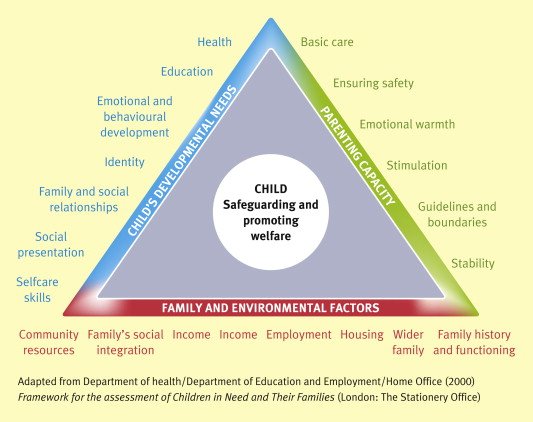
The assessment triangle social work framework is one of the most widely used models in UK safeguarding practice. It helps social workers build a structured understanding of a child’s life by examining development, parenting capacity, and environmental influences together. This holistic structure ensures that no single factor is assessed in isolation, allowing practitioners to form a balanced and evidence-based judgement about risk and need.


In everyday practice, assessment triangle social work is essential for supporting consistent decision-making across children’s services. It is used during early help assessments, child protection enquiries, and ongoing family support work. By encouraging professionals to gather and organise information systematically, the model improves communication between agencies and strengthens safeguarding outcomes for vulnerable children across the UK.
Understanding assessment triangle social work explained
The concept of assessment triangle social work explained refers to a simple but powerful way of structuring professional assessments. Instead of relying on fragmented information, the model encourages practitioners to explore three interconnected domains. These domains create a complete picture of a child’s lived experience, ensuring that both strengths and risks are identified in a balanced way.
When looking at assessment triangle social work explained in detail, it becomes clear that the model is designed to prevent oversimplified judgments. Social workers are guided to consider how each domain interacts with the others. For example, environmental stress such as poverty may affect parenting capacity, which in turn impacts a child’s emotional and physical development.
Core domains within assessment triangle social work
The first domain of assessment triangle social work focuses on the child’s developmental needs. This includes physical health, emotional wellbeing, cognitive development, identity, and social behaviour. Social workers assess whether a child is reaching expected milestones or facing challenges that may indicate neglect, abuse, or unmet needs requiring intervention or additional support.
The second and third domains in assessment triangle social work cover parenting capacity and environmental factors. Parenting capacity includes a caregiver’s ability to provide safety, emotional warmth, guidance, and stability. Environmental factors consider housing conditions, financial stability, community support, and wider family relationships. Together, these domains create a complete framework for analysing family dynamics.
Practical application of assessment triangle social work
In real-life practice, assessment triangle social work is used as a guiding structure during assessments conducted by social workers. Information is gathered from multiple sources, including home visits, school reports, healthcare professionals, and direct conversations with families. This information is then organised into the three domains for structured analysis.
Once the data is collected, assessment triangle social work supports professional judgement by helping practitioners identify patterns and risks. It ensures that decisions are not based on assumptions or single incidents but on a full understanding of the child’s circumstances. This structured approach is especially important in safeguarding cases where quick yet accurate decisions are required.
Assessment triangle social work guidance in UK practice
Assessment triangle social work guidance in the UK is closely linked with national safeguarding frameworks such as Working Together to Safeguard Children. These guidelines ensure that practitioners follow consistent procedures when assessing children and families. They also reinforce the importance of evidence-based practice and multi-agency collaboration in safeguarding work.
In addition, assessment triangle social work guidance is reinforced through local authority policies, supervision processes, and professional training. Social workers are encouraged to use the framework not only as a documentation tool but also as a thinking model. This helps maintain high standards of practice while ensuring that children’s welfare remains the central focus of all assessments.
Assessment triangle social work PDF resources and tools
Many practitioners rely on assessment triangle social work PDF templates and diagrams to support their assessments. These resources provide a visual representation of the three domains, making it easier to organise complex information in a structured way. PDF tools are often used in training, supervision, and day-to-day case recording.
The use of assessment triangle social work PDF documents also supports consistency across teams and organisations. By standardising how information is recorded, professionals can more easily share and interpret assessment findings. This improves collaboration between agencies and ensures that safeguarding decisions are based on clear and accessible information.
Assessment triangle social work in adult safeguarding
Although primarily designed for children, assessment triangle social work can also be adapted for adult safeguarding cases. In adult services, the model is used to assess wellbeing, care needs, and environmental factors affecting vulnerable adults. This adaptation helps social workers understand complex situations involving neglect, disability, or mental health challenges.
In assessment triangle social work for adults, the focus shifts slightly to reflect legal and ethical differences in adult care. Issues such as mental capacity, autonomy, and consent become more prominent. Despite these differences, the framework still provides a valuable structure for organising information and supporting professional decision-making in adult safeguarding contexts.
Strengths of assessment triangle social work practice
One of the key strengths of assessment triangle social work is its ability to promote holistic thinking. It encourages practitioners to move beyond surface-level observations and consider the broader context of a child’s life. This helps ensure that both strengths and risks are identified and addressed appropriately.
Another strength of assessment triangle social work is its support for multi-agency working. By providing a shared framework, professionals from education, health, and social care can contribute more effectively to assessments. This improves communication and leads to more coordinated safeguarding responses for children and families.
Limitations of assessment triangle social work framework
Despite its strengths, assessment triangle social work also has limitations that practitioners must be aware of. One challenge is that the model can sometimes oversimplify complex family situations. Human lives are dynamic, and reducing them into three domains may not always capture every nuance of lived experience.
Another limitation of assessment triangle social work is the risk of over-reliance on professional judgement. Different practitioners may interpret the same information in different ways, which can affect consistency. Time pressures and high caseloads can also impact the depth of analysis carried out within each domain.
Case example of assessment triangle social work in action
A practical example of assessment triangle social work can be seen in a case involving concerns about a child’s school attendance and emotional wellbeing. A social worker gathers information from the school, family members, and health professionals to build a full picture of the child’s situation across all three domains.
Using assessment triangle social work, the practitioner identifies that while parenting capacity is generally adequate, environmental stress such as housing instability is impacting the child’s emotional development. This insight allows professionals to design targeted support that addresses the root cause of the issue rather than focusing only on symptoms.
Best practice when using assessment triangle social work
Best practice in assessment triangle social work involves ensuring that all three domains are explored equally and without bias. Social workers must remain objective and base their analysis on evidence rather than assumptions. This helps create fair and accurate assessments that reflect the true needs of the child and family.
Another important aspect of best practice in assessment triangle social work is effective communication with families. Engaging parents and children in the assessment process ensures that their voices are heard. This not only improves the quality of information gathered but also builds trust between families and professionals.
Conclusion to assessment triangle social work
The assessment triangle social work model remains a fundamental tool in UK safeguarding practice. It provides a structured and holistic approach to understanding children’s needs by examining development, parenting, and environmental factors together. This ensures that assessments are thorough, balanced, and focused on improving outcomes for children.
In conclusion, assessment triangle social work continues to play a vital role in supporting social workers to make informed decisions. Its structured yet flexible approach allows professionals to manage complex cases effectively while maintaining a strong focus on child welfare and family support.